In accordance with the Digital Millenium Copyright Act (DMCA), any material that an individual feels is in violation of copyright(s) may contact the site owner, and if proper documentation is provided and we find that the material in question is of copyrighted material, we will immediately remove said material.
Some of the contents posted in this blog are either obtained in a public domain or the sources was unknow and is intended for educational purposes only. If you own rights to any of the featured images, videos and articles and do not wish them to appear on this site, please contact us by leaving a message and they will be promptly removed.

7 rules To Put The "Ad" Into Adwords
By Peter Astley-Sparke (c) 2008 -Peter runs AdWords Magic, one of the UK's leading AdWords training and campaign management providers.
AdWords' power comes from the ability it gives you to intercept prospects at the exact moment they're looking for what you sell. The basic PPC ad format is simple, and works best with a single clear message and a strong call to action.
7 rules To Put The "Ad" Into Adwords
When you're new to AdWords, it's tempting to devote far too much time and energy in trying to craft that "killer" ad. But the truth is that writing ads is a science, not an art. Here are a few of the rules.
1) Don't Fly Blind...
In over five years developing AdWords campaigns, we've haven't ever seen a profitable example that didn't track conversions.
AdWords Conversion Tracking is simple to install and a "must" for measuring ad performance. Remember, by itself the Clíck-Through- Rate (CTR) of an ad tells you nothing about the ROI it's delivering. We've seen many examples of ads with a lower CTR, but higher conversion rate.
Universal Log File Analyzer - Advanced Web Analytics!
Google Analytics obviously adds a great deal more data, but takes time to master. However, one feature worth using immediately is its ability to tell you which ad position yields the best results.
Finally, don't forget the AdWords Reports section. This has improved significantly over the past year, and the Search Query Performance report is a real asset in optimizing keywords and ad copy.
.
2) Cut out the Middle Man...
In this case, the "middle man" is Google. When developing and testing your ads, it's vital to put yourself in control as far as possible:
Delivery Method: By default, Google spreads the delivery of your ads evenly throughout the day, ensuring you don't exhaust your daily budget (and they get to spend as much of it as possible). However, it also serves to mask the true demand for your product or service. We have seen many cases where ads are more profitable at certain times of the day.If you have a limited budget, spend it when you'll get the best return. We recommend running campaigns using Accelerated delivery. Keep an eye on your daily budget and adjust accordingly.
.
Ad Serving: If you're running multiple ads, Google will automatically start favouring the one with the highest CTR once a certain volume of clicks have been receíved. We don't use the default Optimize option, and recommend you select Rotate for ad serving.
We have AdWords campaigns for some of our clients that have been running for over three years, but we always maintain at least two ad variations per ad group. Even if there's only a single word difference, one ad will ultimately prove superior and deliver an improved ROI.
The Rotate option also gives you more granularity when testing ad variations. Say you can creat a 1/3-2/3 split; you simply create two copies of ad "A" and one of ad "B". Using the same principal allows you to create 60/40 and 70/30 splits, which are very useful in some circumstances.
Forget Expensive PPC Advertising - There is an Alternative!
Network Options: Start your testing using Google's Search network only. Uncheck both their Partner and Content networks. Once you have some solid data from mainstream search traffic, you can add their Partners. Google's partners are a pretty "mixed bag", and you may decide to exclude them altogether (we often do).
Enable the Content network and Content Bids. Don't run on the Content network with the same bid as Search - you're just handing Google money. By default, we set Content Bids at 1/10 of that on the Search network: so if your Search bid is 0.50p, set your Content bid to 0.05p for openers.
If you find your product or service has "traction" on the Content network (true in about 25% of cases in our experience), it may be worth running separate campaigns for Content searches.
.
All these options can be set from the Campaign Management tab in your account. Select a campaign and clíck the Edit Settings button.
.
3) A Stitch in Time...
It's important to optimize your ads (and separately your keywords and bids) to a fixed schedule. By default, we run a three-month cycle: Every three hours for the first day. Every day for the first week. Every week for the first month. Every second week for the second month. At the end of the third month.
You can adapt this schedule to suit your clíck volume, but make sure you have a schedule and stick to it. You'll learn more about your target audience, and employ your time more efficiently. Don't forget to take weekdays, weekends and seasonal trends into account.
.
4) Study your Competition First...
Before writing your first ad, take time to study your competition using a selection of core keywords and phrases.
This is particularly important if you're thinking of using Google's Keyword Insertion feature. This is becoming increasingly popular and can be counter-productive; making your headline look identical to the competition.
,
5) All for One and One for All...
Achieving a good Quality Score, and providing visitors with a rewarding experience, means treating your keywords, ads and landing page as a single unit.
Ensure your most popular keywords appear in your ad's headline and copy. If you cannot accommodate core keywords in your ads, segment your ad groups further.
.
Make sure core keywords follow-through to your meta data and landing page copy. Try to write ad copy that flows naturally and qualifies visitors to your site. If you sell software for Microsoft Outlook, for example, a headline such as "Using Microsoft Outlook?" will help avoid Apple users, who might find your product of interest, but are unlikely to become customers.
6) Simplicity Sells Harder...
Capitalize letters and words in your ad copy for emphasis (not all the time). Capitalizing the first letter of every word in your copy actually makes reading more difficult.
Be honest and don't use words like "free" unless you're really giving something away for free within 3 clicks of your landing page.
.
7) Understand what Matters...
According to research undertaken by Google, the headline of your ad represents 40% of its impact. The first line of copy accounts for 25%, the second line 20% and the Display URL 15%.AdWords' power comes from the ability it gives you to intercept prospects at the exact moment they're looking for what you sell. The basic PPC ad format is simple, and works best with a single clear message and a strong call to action.
Helpful Resources:
The 10 Step Plan To Successful Email Marketing
By : Matt Jackson, founder of WebWiseWords, offers SEO copywriting and a range of other web content writing services.
"once a list member purchases from you, and presuming that everything goes smoothly during and after the sale, they will be more inclined to purchase from you in the future. You will have won their trust, gained their favor, and they can be relied upon to help you with extra sales in the future."
The 10 Step Plan To Successful Email Marketing
When website owners and marketers talk about online marketing, they often refer to SEO and PPC. Email marketing can sometimes be overlooked despite being one of the most powerful methods to reach potential customers and to keep existing customers coming back for more. Perhaps a factor in this is that direct email campaigns are commonly associated with spam emails, but careful list management ensures that this need not be a problem.
.
There are a number of stages to a successful email marketing campaign and by nailing as many as possible you can improve your results. The key to success, though, most commonly lies in the planning stage if this is your first foray into email marketing then be prepared to treat it as a test run. The more direct email marketing campaigns you run, the more opportunity you have to optimize the process and improve your results. Here are ten of the most important steps to an effective email campaign.
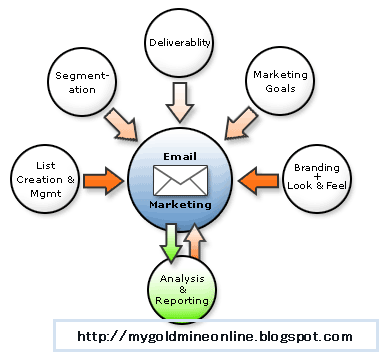
1. Determine Your Ultimate Goal
This might sound obvious, but having a clear goal in mind will help to concentrate your efforts. There are many effective uses of an email marketing campaign from increasing brand awareness to pushing a new product or seasonal promotion. Each of these uses typically demands a different campaign with its own style and its own components.
Increasing traffic to your website is not usually a bottom line target. The reason for increasing traffic to a website is normally to improve sales and increase profits. In the majority of cases, it is more desirable to attain greater sales through fewer visitors, than having a site awash with visitors but with a poor conversion rate.
A prolonged and careful email marketing campaign will naturally help to improve brand awareness. Your readers will naturally remember your name and the products or services that you sell as they gain more and more exposure to your marketing emails. Similarly, as long as you produce relevant and useful emails, your potential customers will grow to trust you making it more likely that they will purchase from you now or in the future.
2 - Your Opt-In Email List
There are a couple of key aspects to this section. YOUR opt-in list will generate better results than the use of somebody else's list. If you have taken the time and put in the effort to grow your own list, then the members of that list will already have some degree of awareness for you, your products, and your website.
Developing your own list can take time and money. To get a head start it is possible to buy or rent email lists from others. In these cases it is particularly important to pay attention to the second important factor of the list MUST be an opt-in list. Every member of that list must have opted in to receive marketing communication from you and they MUST be given adequate opportunity to opt out of future communication.
Particular care needs to be taken with your list management techniques to ensure that you are not deemed as being spam. If you purchase lists or partial lists then members that opt out need to be recorded separately. If you purchase another list that includes the same name and you subsequently email that person without their express request to be re-included in your list then you face the very real possibility of being flagged as sending spam email.
3 - Establish Performance Tracking Techniques
Tracking the performance of any advertising campaign should be foremost in your mind. This is the only true method of determining its worth and is the only way you can optimize your advertising to generate the best possible results. Web analytics are an absolute must-have, and with the wealth of affordable and even free choices available today there is no reason not to have a good analytic package in place.
Tracking code can also be placed into an HTML email. You need to operate a degree of caution when implementing code into HTML emails, because it could lead to your email being blocked by over zealous spam filters. If you can use hyperlinks that include tracking code, and your analytics package includes referral data, then this can generate the majority of the information you require.
The more information you can gleam from an advertising campaign, the better. You will be using these results to fine tune future advertising campaigns, so too much information is better than too little. If in any doubt then consider using an email marketing management service to conduct the tracking on your behalf.
4: Web pages are optimized to complete the sale
Directing visitors to your website is only a portion of the battle ahead. Once they clicks through the links in your email, you then need to be confident that your web pages are optimized to complete the sale. Conversion rates need to be high on the pages you direct traffic to, but you also need to target the traffic to the most appropriate pages and vice versa.
Consider the anchor text, or link text, that you will be using in your email. If you are encouraging readers to learn more about a product then don't direct them straight to the purchase page unless that page includes the inferred information. Similarly, if you have pre-sold your readers so that they are poised and ready to buy, and your CTA (Call To Action) indicates that this is the next step then you can navigate readers through to a more direct sales page.
Introducing a new product or a new concept will usually take more information than you can provide in a single marketing email. If necessary, add a page or multiple complementary pages, to your website. Direct readers to these pages so that you can combine the use of your email marketing and your optimized and informative content to really persuade and hammer the message home hard.
5: An Effective Subject Line
The subject line of your email is the first thing your readers will read, and you need to ensure that it won't be the last. Human spam filters can be just as difficult to avoid as software spam filters, even for genuine email. You should certainly avoid the use of typically spammy subject lines and opt for a more effective approach.
There are many ways to write an appealing subject line. A newsworthy subject line will often grab the attention but only works effectively in limited cases. Otherwise, try to evoke an emotive response from the reader. The strongest emotions include greed, love, and even hatred or controversy. With these latter two it is again important that you exercise appropriate caution otherwise you may alienate your readers against this and future marketing emails.
Intrigue and appeal work very well. An intriguing headline will draw your readers into the main body of the content and the subject line will have then done its job effectively. Never mislead in the subject of your email but do try to peak your reader's curiosity to the extent that they can't help but open the email and read it fully.
6 - Email Body Content
Finally we reach the main body content of the email. That it's taken to point six to do so is an indication of how important the planning and preparation stages are. The subject line has hopefully driven a good portion of your list to open the email, and those readers should be intrigued enough to want to read more.
Research shows that the more personalized the message, the more likely it will be to succeed. Start with a personalized greeting and use a friendly, even conversational tone, throughout the message. Inform readers of what they need to know but do so informally and in as friendly a manner as is possible by email.
The email absolutely has to be grammatically and factually correct, and must not contain typos. These types of errors can be an instant turn off for readers. Run a spell check. Twice. And then check it manually and have somebody else check it again for you. At the same time check the links and ensure that they do indeed direct to the proper pages.
Include a Call To Action, or CTA, rather than just a link. A CTA is a direction that points your visitors to perform your desired action. This could be to click a link, make a purchase, or even forward the email to friends. The CTA needs to be clearly defined an, obviously, as effective and accurate as possible.
7 - Hyperlinks To Your Site
The entire point (although probably not your ultimate goal) of your email is to get readers to click on links and visit your website. Include two or three links in the body of your email and make sure they are relevant without being too obvious. Lead you visitors to click the links rather than directly point it out and find something more effective than "click here" to use as your anchor text.
Two to three links is the ideal number. Too few links and your email won't prove effective at driving traffic, while too many links will detract from the actual content of the email. If your email is very short then offer two links, or offer three links within longer messages. Contextual links (that is, those that appear within the body of the email rather than at the end) are usually significantly more effective.
Check and double check that links work and direct to the correct page. Once you've done this, have somebody else check them too. The number of marketing emails that have failed because of broken or incorrect links is alarmingly high and this is not a trap that you want to fall into.
8 - Choose The Best Time To Send Your Email
The time you send your email can have a significant impact on its effectiveness. During the night, most people's emails fill up. In a lot of cases, this can mean that your reader will be faced with tens of emails in the morning, many of them rubbish. This leaves a very real chance that they will simply ignore or delete your email without noticing who sent it, what it is about, or whether they have any interest in reading it.
Consider your target market and when they are most likely to be sat in front of their email. Those with a global market may find this more difficult because of the time difference, but otherwise bear this in mind too. Not every website or marketing email is geared towards residents from the same country.
9 - Test Email
Initially, send a test email to yourself, friends, family, or colleagues. This is more to determine that it arrives looking as expected. Once you have done this and are happy with how your email looks, you should then move on to send a second test email to a small selection of your list. This gives you ample opportunity to make any last minutes changes or tweaks according to how this small test run performs.
You might even consider sending several tests out to different groups, if you have a large enough list. This enables you to test the subject line, content, and product price, by making alterations before each test run. Be sure to test the different components separately, though, so that you can determine what needs changing and what works well.
A test email also gives you chance to check that you are set up and able to track the results and any other information you want to track. A good email marketing service will do this by default, because the test email can prove to be one of the single most effective ways to improve the performance of a one-off email shot.
10 - Monitor, Optimize, And Start Again
Being careful not to send emails too frequently, you should send regular communication to your list. An unloved list will be more likely to unsubscribe and readers become most responsive after approximately seven items of communication from you. Monitor results, check bounce rates, and look for ways that your campaign could be improved.
Once you've found the best ways to improve a campaign make the improvements and begin the procedure again from the beginning. This process of monitoring, optimizing, and starting again will help to increase exposure, improve brand awareness, and generally improve results and profit levels.
Why Your List Is So Important.
.
A list can last you a lifetime and it is possible to continue selling to the same list members over and over again. In fact, once a list member purchases from you, and presuming that everything goes smoothly during and after the sale, they will be more inclined to purchase from you in the future. You will have won their trust, gained their favor, and they can be relied upon to help you with extra sales in the future.
.
Take care your list and your list will take care of your profits.
Keyword Research and Analysis - The Art of Internet Marketing
By:Keith Raymond .AVancouver Internet Marketing and Search Engine Optimization .Specialist. Internet Marketing includes keyword research and analysis, search engine optimization (SEO), creating compelling web content, and producing online marketing strategies. Visit Netsurf Marketing to learn more about Internet marketing strategies to turbo charge your web presence.
Different search engines have different rules about how these tags are used and how many characters they should contain. Of importance to the process is if you know how the big three - Google, Yahoo and MSN - review the tags, then you'll be targeting 90% of potential web surfers.
Keyword Research and Analysis - The Art of Internet Marketing
The first step in successful SEO copywriting is choosing the right keywords to make them very specific to your market. You can survey your target market for their keyword usage or use more thorough keyword research tools. When conducting the keyword research and analysis:

4 Keywords rules for Your Website.
1) Use keyword phrases containing two to four words
2) Be specific - geographically, topically, or by product
3) only use the keywords that are important to your web business
4) Avoid very competitive keywords or general keyword phrases
Use focused and targeted keyword phrases that are common enough so the web searcher will use them, but selective enough that they don't return millions of matches. Most web surfers use a two to four word phrase when they search online, so phrasing is very important. For example, if you are offering a service like dog training or Internet Marketing, you wouldn't target the key phrase "dog training" or "SEO", but something more specific like "Chicago dog trainer" or "Vancouver Search Engine Optimization". Very specific keywords generate highly qualified, targeted traffic that increases your sales opportunities.
The Wrong Keywords for Your Website
Single words cannot promote ranking or sell effectively, for example you wouldn't and never target "dog" as a dog trainer in Chicago. Avoid the most popular keyword phrases or general keyword phrases because you'll be competing with millions of other web pages for a search engine ranking.
It's unrealistic to think that a new web site could rank number one on a popular phrase like "Marketing". You are better to target "Internet marketing strategies" or even better, "Internet Marketing Strategies Vancouver". More established companies who have been on the Internet for several years will have the advantage of link popularity and a high Pagerank and therefore better rankings in the search results for these broader or general keyword phrases.
Search Engine Optimization - Feeding the Search Engine Machines
Another critical factor to help drive the targeted visitors to your site is optimizing the site using metatags. Metatags, often overlooked and misunderstood, are elements of HTML coding on a website. Search engines use these metatags to help them determine what the site is about and assist with indexing a website. Most metatags are included within the 'header' code of a website. The most important tags are the title tag, description tag and the keywords tag. Different search engines have different rules about how these tags are used and how many characters they should contain. Of importance to the process is if you know how the big three - Google, Yahoo and MSN - review the tags, then you'll be targeting 90% of potential web surfers.
To make good use of your metatags use your targeted keywords that you found during your keyword research and analysis in the site copy and the metatags.
By reviewing or crawling your website content and metatags, search engines will find out what your web site is about. As soon as search engines consider your web site relevant to the topic or search, the easier it is to get high rankings for your keywords and key phrases.
Two pronged approach to building links
By:Bruce Swedal - Gain an online presence for your Website by getting listed on The Authority Website Directory.
You can have the best website on the internet, but without proper promotion your visitors will never find you. If they do not find
you, they cannot use the services that you provide
Two pronged approach to building links
You should consider taking a two pronged approach to building links. The first method for building links is through submissions of your
site to quality webs directories.

Every link you get to your site is not only a vote in popularity, but also a doorway for new fresh visitors. Every quality link you can get through directory submissions will bring more relevance to your site.
How you can use article marketing.
The first way you can use article marketing is by going to article directories. If you can't write your own unique content (which is
preferred) for your site, you can use the content from article directories to place on your site for content as long as you retain the
authors resource box. You need the content there for the search engines to spider when they visit through all the linking pathways you
created when submitting your site to quality web directories.
As we covered the internet contains a massive amount of information and people search for it every day. The more links you have pointing
to your site and the more content you have on it relevant to your sites niche, the better you will rank for search engine queries.
Another way to use article marketing is by writing your own unique articles on topics related to your websites niche and submit them for
publication to the best article directories. These articles will create some links to your website to increase its popularity and with
each link comes another doorway for traffic to find you.
When you write and publish these articles, you are also letting the public know you have expertise and knowledge on the subject. To get
the reader's attention, give them a quality, well written article filled with information.
Build links through quality directory submissions to increase your site's popularity and create doorways to traffic and search
engines. Then use article marketing to provide quality on-site content for the search engines to spider when they arrive.
The more quality web directories you submit your site to, the more article content you provide on your site and the more articles you
submit for publication on article directories, the more search engines will love your site.
These are some of the key elements to creating traffic and building a successful website. You can have the best website on the internet,
but without proper promotion your visitors will never find you. If they do not find you, they cannot use the services that you provide.
Now it is time to get started.
7 basic rules to follow for Internet Marketing
By Mark McCullagh .Author of the internet marketing strategies that work, especially for network marketing.
Simple changes DOUBLE the productivity of an ad. It's not only amazing, but also a lot of fun! Marketing takes
work. You simply cannot get something for nothing. Massive action creates massive results.
7 basic rules to follow for Internet Marketing
http://mygoldmineonline.blogspot.com/
Internet marketing strategies involve driving targeted (people who are interested in what you have to offer) traffic to your website, blog, or sales page.That traffic then has to be converted into sales. This simple formula illustrates this process:
Traffic + Conversions = Sales
Keeping this formula in your mind will help you in your internet marketing efforts because you will realize that you not only have to generate traffic, but also turn those visitors into buyers.Furthermore, here are 7 basic rules to follow when applying this formula. These rules are relevant to all forms of marketing but are especially important for online marketing where inexperienced people can "burn" a lot of money quickly and become very discouraged.

1. All marketing involves RISK.
Whether you are trying something new or "copying" a strategy that has brought good results for others, there is still an element of risk.
When speaking of risk, you tend to think of gambling which makes for an appropriate analogy here.
For internet marketing, we try to reduce the risk and swing the odds in our favour by doing keyword research, learning skills like ad writing, article marketing, and pay per click, and other general marketing activities such as knowing what your target market is interested in.
2. Test small first.
Reduce your risk by testing a marketing approach on a small scale first. If it works, then increase the scale and create momentum.
This is how to make money!
3. Be consistent.
Successful marketers do something to propel themselves forward everyday. That is their secret.
A good practice is to create a to-do list every night featuring 5 actions that you must complete the following day.
By doing this at night before you go to sleep, you engage your subconscious mind and the next day you will know what you have to do and be on target to complete these tasks.
This is a very powerful process. Try to do this, one day at a time, until it becomes a daily habit.
4. Set a budget.
Determine what you can afford to spend on advertising on a monthly basis. In this way you can set and manage your expectations.
This should also prevent you from trying things you cannot afford.
5. Diversify.
Spread your efforts as much as you can over many different sources. This will also reduce your risk and help you to discover what works.
Remember that if one internet marketing method that you try does not produce results, you have not failed. This just means that you are one step closer to finding something that DOES work.
6. Learn how to write effective copy.
The skill that will make or break you in internet marketing is copywriting.
It is especially important to learn how to write headlines. There is a ton of good information online that is free regarding headlines and copywriting. Just do a Google search.
7. Take action, test, and track.
Tracking is essential because you absolutely need to know the results of your marketing efforts.
Once you start getting results, you can employ simple tests to see if you can improve. Often this testing involves strategies that are free.
One such strategy that comes to mind is split testing. You can do this for free, and it can provide incredible returns. Generally speaking, split testing involves making slight changes to a landing page or adwords ad, often just the wording of the headline, and testing it against a current version.
I have seen very simple changes DOUBLE the productivity of an ad. It's not only amazing, but also a lot of fun! Marketing takes work. You simply cannot get something for nothing. Massive action creates massive results.
So take action and do not be afraid to fail. Remember to minimize your risk.
How to Use Offline Advertising in Internet Marketing
By Andre Sanchez - How to Use Offline Advertising in Internet Marketing was originally published at http://www.affiliatemarketinglife.com.
Online advertising methods are very effective in internet marketing, since they can be visible to people all round the world, but if you know how to use offline advertising it can also work very nicely for you, and bring you a lot of business you would not otherwise have
How to Use Offline Advertising in Internet Marketing
Knowing how to use offline advertising in internet marketing can give you a significant advantage over your competitors, since many do not use offline methods to advertise their products.

Offline advertising is particularly relevant if you are selling a product, or offering a service, that attract customers locally. For example, you could offer a fitness aid at your local leisure center. Many leisure or fitness centers will allow you to put a free poster offering your product, but even if they charge you for it the price is usually small. Perhaps you have a golf training aid that you can advertise at your local golf club.
Local classified ads are also a good means of getting your product some local publicity. The classified ads pages or even adverts placed on selected pages of your local press, frequently provide you with local orders. The beauty of these is that they are very easy to follow up, either with back-end products or new ones. You need not even restrict yourself to the local press. How often have you seen an internet marketing advert on the national press? They are not uncommon, and although expensive, they must produce a good return.
If you have a niche website, it could be worth your while browsing round your local newsagent and checking out the magazines on display. You know the kind - all these racks upon racks of magazines on every topic you can think of. Have a word with the newsvendor and find out some of the more popular magazines that cover your niche. These could be good publications for placing your adverts, especially if they are not too expensive and they have a good circulation.
Poster campaigns can also work well. You can advertise with posters in many shopping malls, and some stores also offer you the opportunity place an A5 poster for only pennies a week. Have your own business cards printed with your internet business contact details, such as website address and email address in addition to your phone number. Put your website address on everything, and have a signature that use on all correspondence. Not just emails and forum postings, but also offline correspondence such as letters, invoices, receipts and anything else you send to other people.
Another form of offline marketing that most people have never heard of, let alone use, is buzz advertising. This type of advertising has been growing in popularity recently, especially by offline businesses. It is used extensively by some auto companies and by cosmetics companies. Buzz advertising involves getting a verbal buzz going about your website or product. Some companies pay people specifically to verbally promote their products by approaching strangers, striking up conversations and bringing up the product in the conversation.
"Say, have you heard about the latest perfume from ----!" While not yet common it is getting more popular. Of course, the buzz need not be started off by someone you have employed to do it, but you can do it yourself. You can get your family and relatives involved as well. Before you know it, everybody might be talking about your product or your great new website. That's how YouTube and MySpace got so popular.
If you have a van or pick-up get your business name and website address painted on the site. It's easier to get a buzz going if people see your website in their face all the time, on vehicles, on posters, in newspapers and magazines, and even chalked on walls! Well, perhaps not the last one, but that would sure get people noticing your website! Do you get the idea? Get your website name known in every way that you can.
How about a local radio slot, with you explaining the virtues and benefits of your product, service or website? Stress the benefits, and you need not restrict it to local radio. Try for a national radio slot or even TV if your business is sizeable enough. There are no restrictions to the advertising methods you can use. Hire a loudspeaker and shout it from the rooftops!
Online advertising methods are very effective in internet marketing, since they can be visible to people all round the world, but if you know how to use offline advertising it can also work very nicely for you, and bring you a lot of business you would not otherwise have.
Subscribe to:
Posts (Atom)

 Posts
Posts

